

Launching soon
Clear eyes on every market.
A team of AI agents and a trading desk that researches, plans, checks every trade for risk and executes, while you stay in control.
Every trade passes 27 risk rules · Every stock trade has a stop at the broker
One desk, your way
Let it trade. Sharpen your own. Your call.
- 01
Autopilot
Let it trade for you.
The agents research, the desk plans the day, the risk engine checks every trade and the executor places it, inside limits you set. Approve each trade with a tap, or let it run.
- 02
Tools
Sharpen your own trading.
Write your rules once and the Risk Guardian holds you to them. The behavior coach, the Strategy Studio, the options payoff lab and learning paths, for the trades you place yourself.
- 03
Wealth
Grow your wealth for the long run.
Glaux Wealth, your personal financial advisor: goals in a conversation, an honest answer to whether you can get there, a long-term portfolio rebalanced with your approval.
The problem
Thousands of charts. Hundreds of filings. One desk that never blinks.
Nobody reads every filing, watches every chart and keeps every rule, every day. Glaux reads them all before the open and hands you only what matters, as flags with their sources.
- 223
- names on two watchlists
- 10
- rule-based strategies
- 27
- risk rules in code
- 8-K item 3.02KITE · offeringHigh severity: new shares are being sold.
- CalendarLUMA · earnings todayMedium severity: no new swing entries into the report.
- Form 4ORBT · insider clusterTwo insiders bought within 30 days: a booster.
Illustration · fictional tickers and headlines
Meet Glaux
One desk. Every view, live.
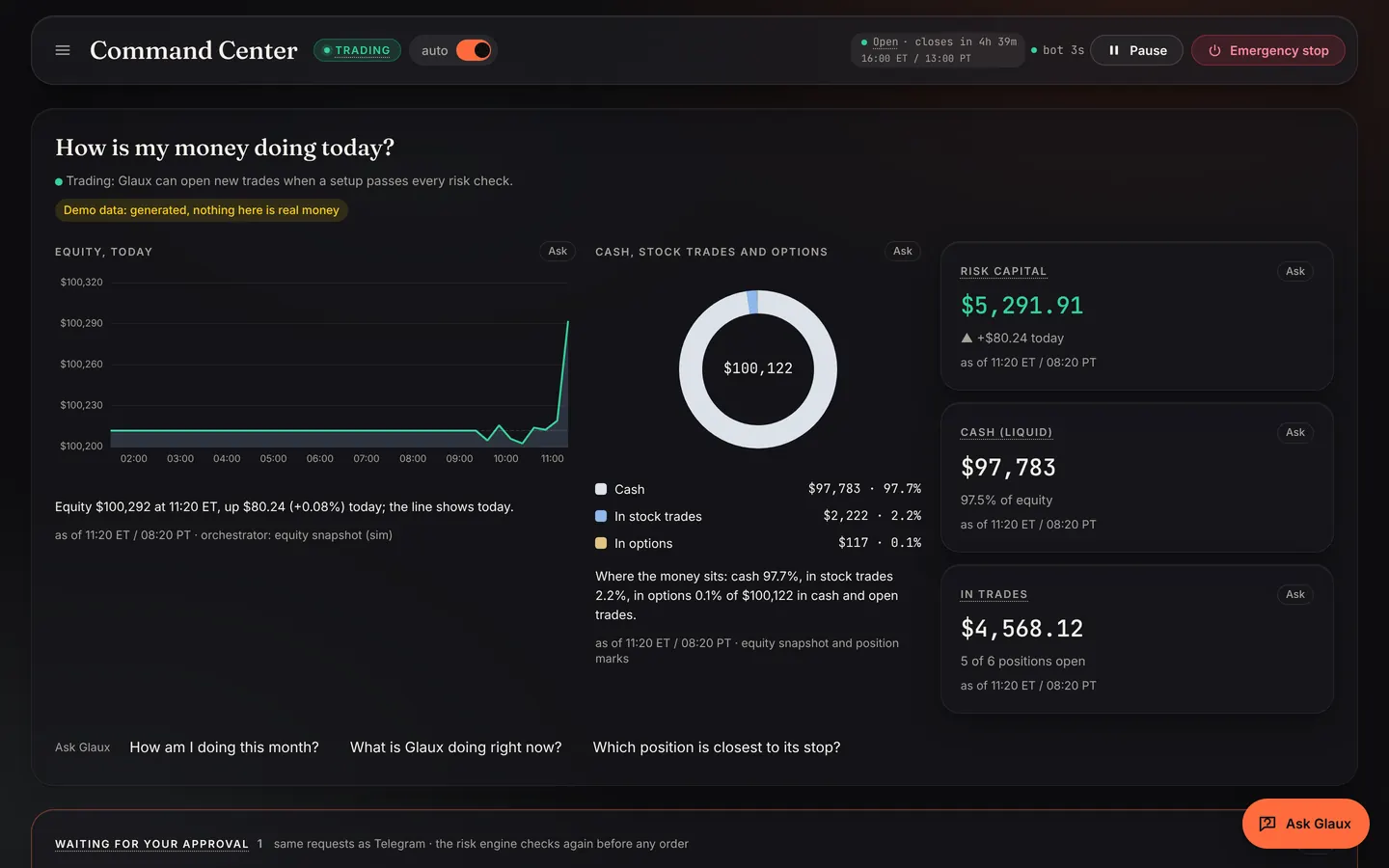
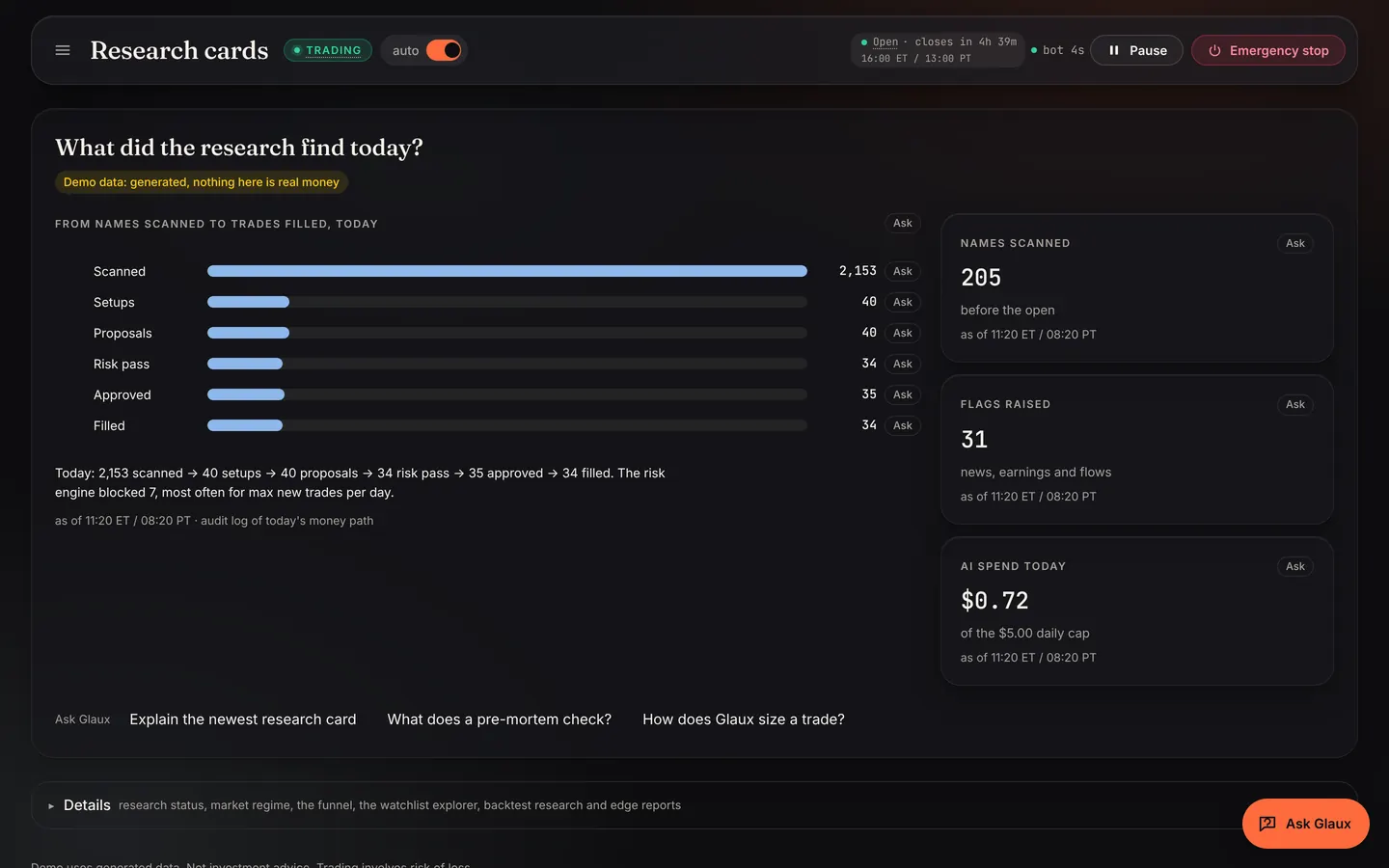
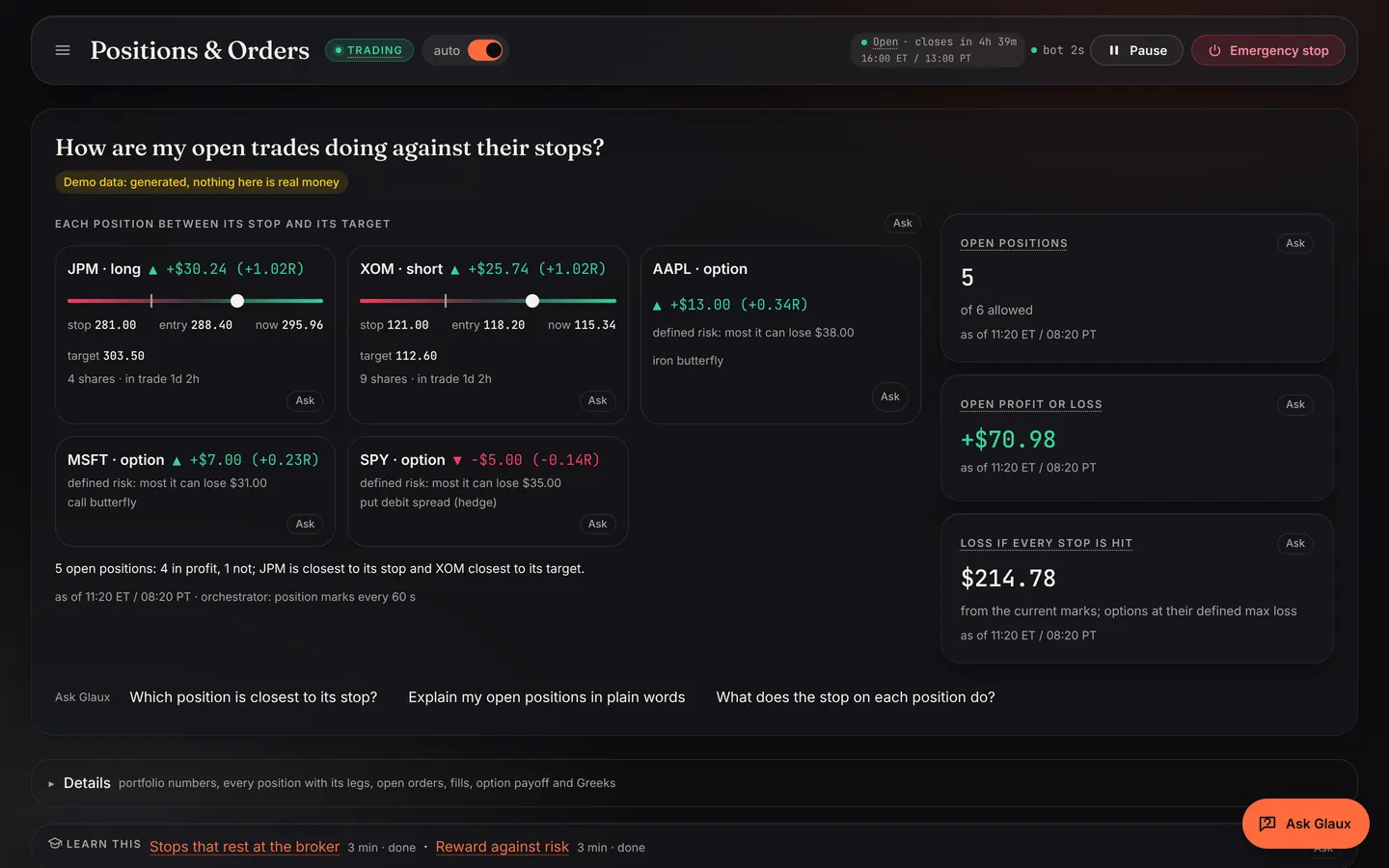
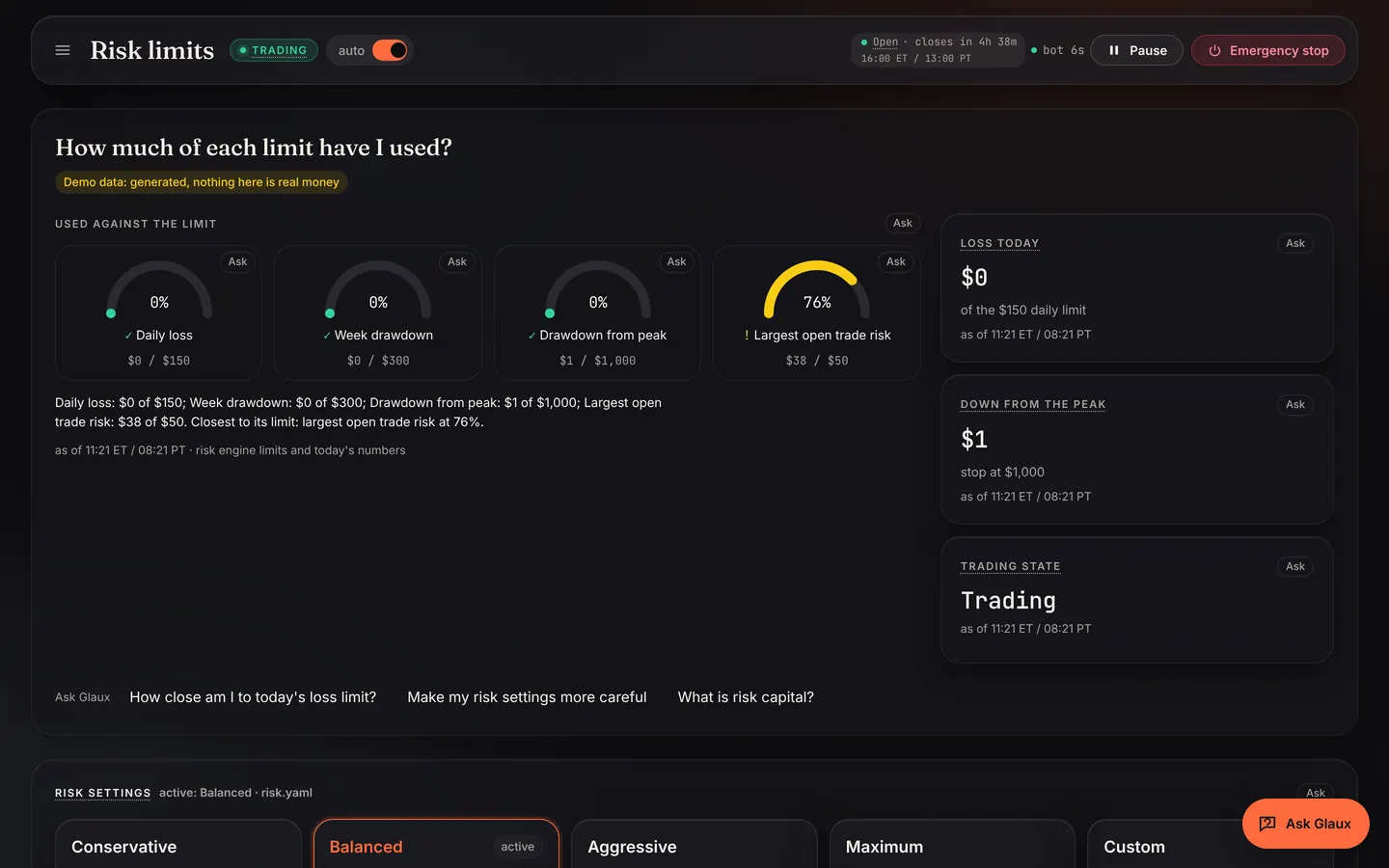
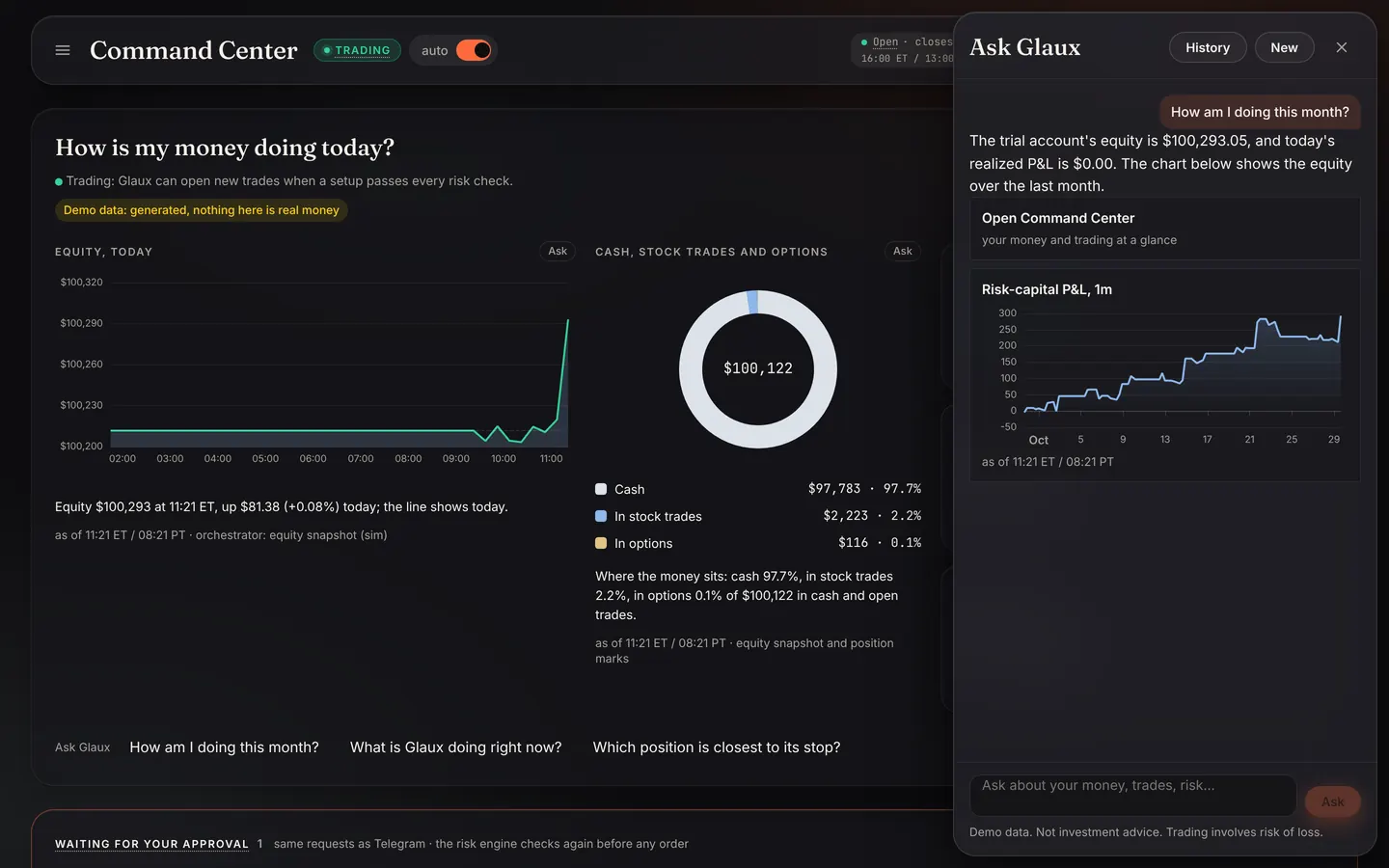
The control center shows the money, the research, every position and every risk limit as it happens. These views are the public demo with generated data.
- Command CenterLive P&L, the equity curve and every step of the desk in the activity feed.
- ResearchThe agents' flags with their sources, the quality score and the direction of estimates.
- PositionsEvery leg of an iron butterfly, its payoff and Greeks, and the stop resting at the broker.
- RiskEvery rule as a meter, with the kill switches and how close each limit is.
The agents at work
Six specialists. One desk.
Each agent has one job and shows its work. None of them can place an order or invent a number: they read, explain and argue, and code holds the money.
-
01 / 06
News & Catalyst agent
Reads headlines, SEC 8-K items and the earnings calendar in the pre-market run, and flags earnings, offerings, guidance cuts, legal and merger news, each with its source.
-
02 / 06
Fundamental researcher
Reads the latest quarterly filings. Code computes a quality score from 0 to 100 out of the reported facts; the agent explains it and judges which way the business is heading. It can restate the score, never change it.
-
03 / 06
Chart analyst
Code detects the setups: breakouts, bull flags, fair value gaps, order blocks and liquidity sweeps. The agent explains each one in two plain sentences, using only the computed levels.
-
04 / 06
Smart-money tracker
Follows insider purchases, unusual options volume and congressional trades. When two or more insiders buy the same stock within 30 days, that is a signal.
-
05 / 06
Pre-mortem agent
Writes the strongest case against every planned trade before it reaches you. It can flag a plan; it can never change a size, a price or a risk decision.
-
06 / 06
Evaluator
Scores every strategy after the close and writes a weekly review with up to three proposed rule changes. Proposals only: you decide, and code demotes what stops working.
Then the code engines take over. The AI proposes. The code decides.
- Strategy engine11 rule-based strategies turn setups into plans: entry, stop, target and size.
- Risk engine27 rules and the final veto on every order.
- ExecutorBracket and multi-leg orders, reconciled with the broker.
- Bracket orderEntry, a target, and a stop resting at the broker.
The 27 rules, in the order the risk engine checks them
- trading_state
- kill_switch
- expired
- invalid_numbers
- tier
- stale_data
- stop_required
- structure_mismatch
- defined_risk
- options_level
- max_loss_mismatch
- max_loss_per_trade
- min_reward_risk
- daily_risk_budget
- max_weekly_drawdown
- max_open_positions
- max_new_trades_per_day
- position_exists
- max_per_name
- max_per_cluster
- day_entry_window
- pdt_rule
- earnings_day
- earnings_blackout
- short_not_allowed
- stale_buying_power
- margin_buffer
Ask Glaux
Ask it anything.
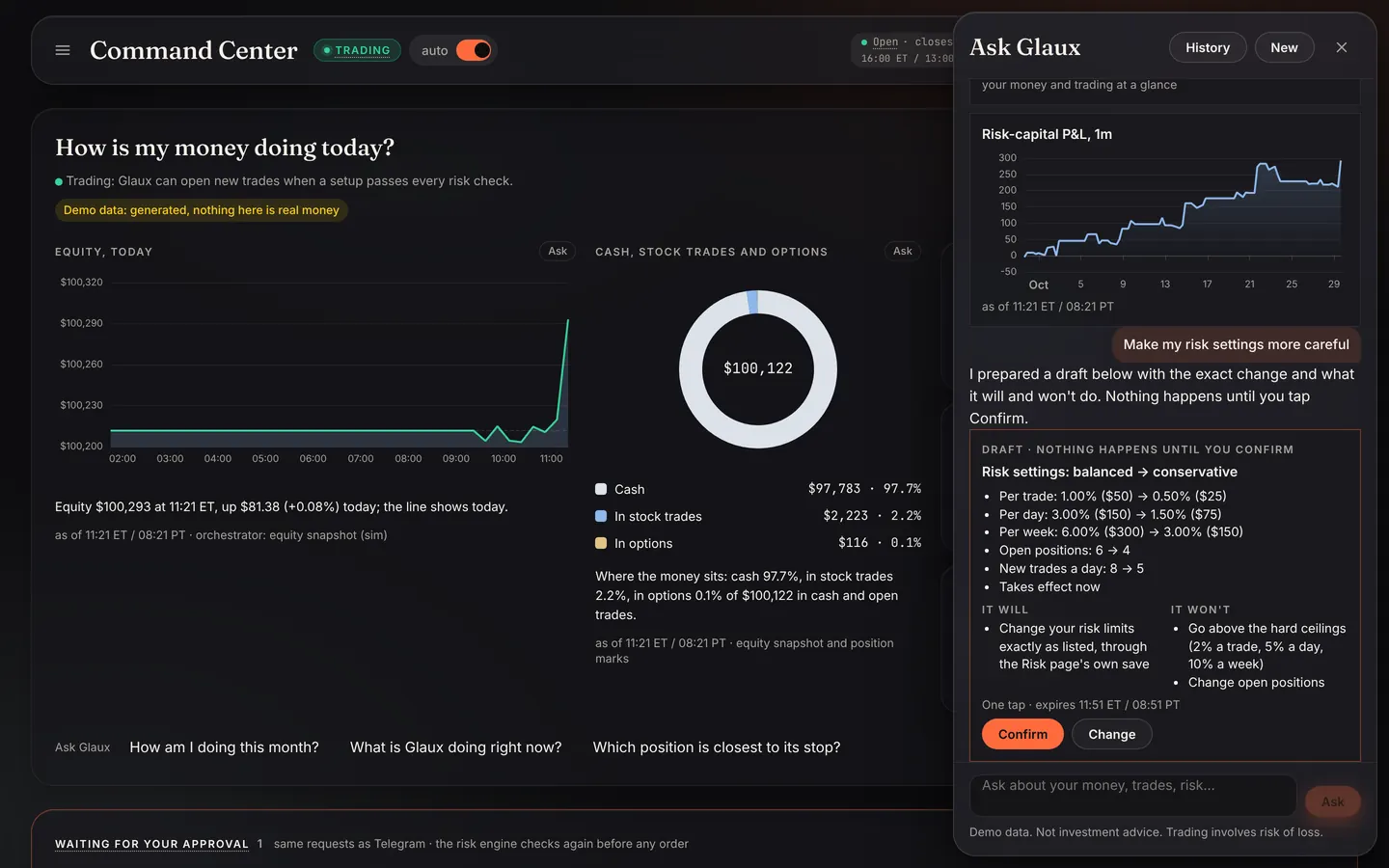
Why did we buy this? What is my risk today? Glaux answers in plain words with your own numbers, every one checked against your data, and draws the chart for you.
- Want to change something? Glaux drafts it. You confirm it. Nothing happens until you tap Confirm.
- It can never place an order, move money or invent a number: the AI proposes, the code decides.
- You choose how much to hand over: approve each trade with a tap, or let it run inside limits you set.
How easy a trade is
Your part is one tap.
Six steps from a setup to a closed trade. Five of them are the desk's.
Plan · swing breakout
Long LUMA
- Entry
- breakout
- Stop
- under the base
- Target
- twice the risk
- Size
- by code
Why: closed above the 20-day high from a tight base.
Pre-mortem: pass.
Risk engine
27 / 27 passed
- stop_required
- max_loss_per_trade
- min_reward_risk
- daily_risk_budget
- max_per_cluster
- earnings_blackout
Approval request
Buy LUMA?
Swing breakout · stop and target set · risk PASS
Expires in 4 min. Silence means no.
Confirm it's you
Face ID
Approve: buy LUMA
Bracket order
- Entry filled
- Stop resting at the broker
- Target working
Command Center
Exited at the target
On its own, by the bracket.
- 1
Glaux finds a setup and writes the plan
Entry, stop, target and size, the reasons, and the pre-mortem's case against it.
- 2
The risk engine checks all 27 rules
Any one of them can say no, and it says which one.
- 3
Your phone shows the approval card
On Telegram or in the control center. Silence means no: a request that expires is a rejection.
- 4
You tap Approve
In the control center your passkey confirms it, with Face ID or Touch ID. That is your whole part.
- 5
The bracket order goes out
Entry and target, with the stop resting at the broker from the moment it fills.
- 6
You watch it live
In the Command Center. It exits at the target or the stop on its own.
Markets and strategies
From the opening range to defined-risk options.
US stocks, ETFs and options across two watchlists: AI infrastructure, and large caps across all 11 sectors, 223 names. 11 rule-based strategies, each with its rules in code.
Glaux Wealth
And for the long run.
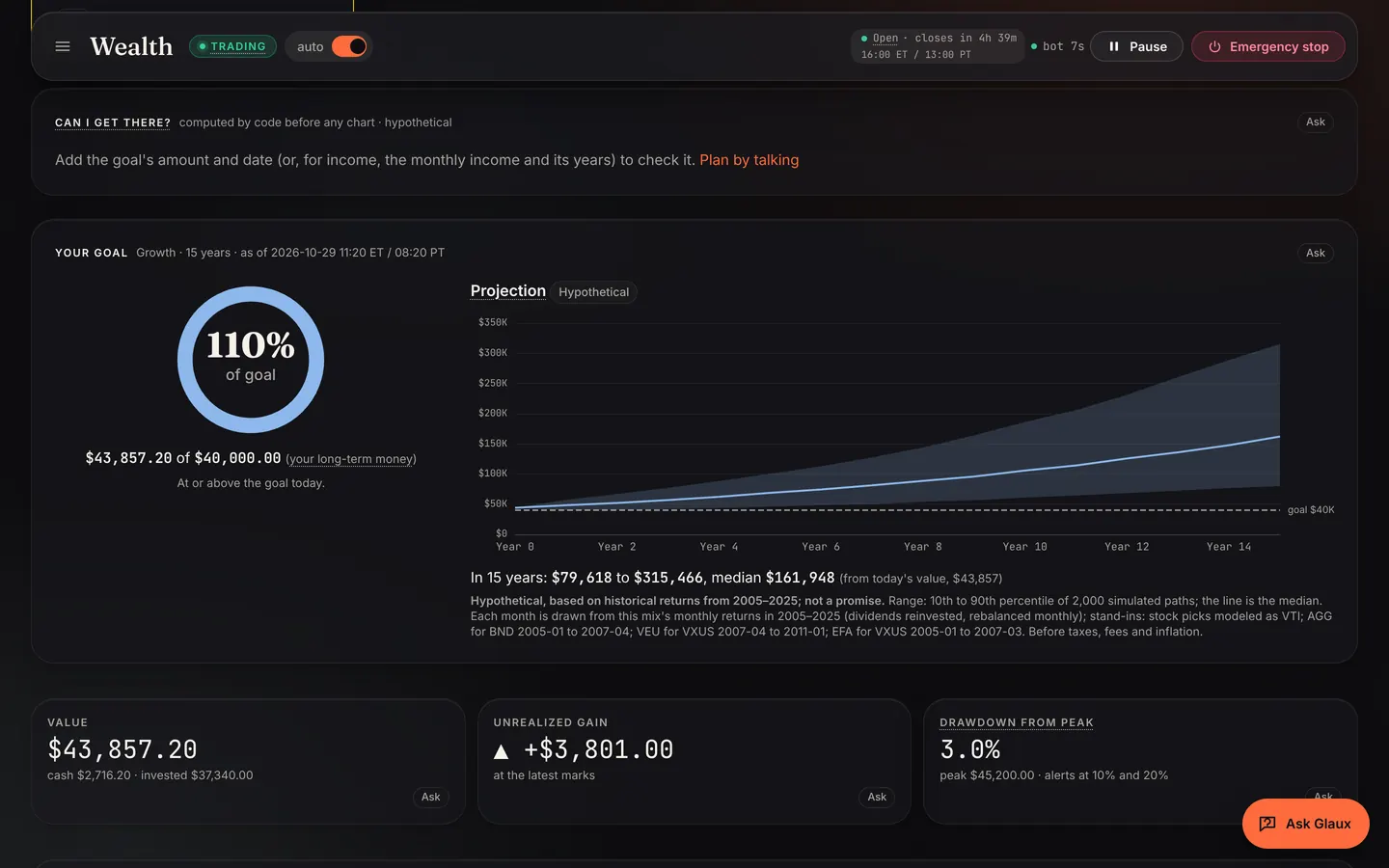
Glaux Wealth is your personal financial advisor. Tell it your goal in a conversation; it shows honestly whether you can get there, and what it would take.
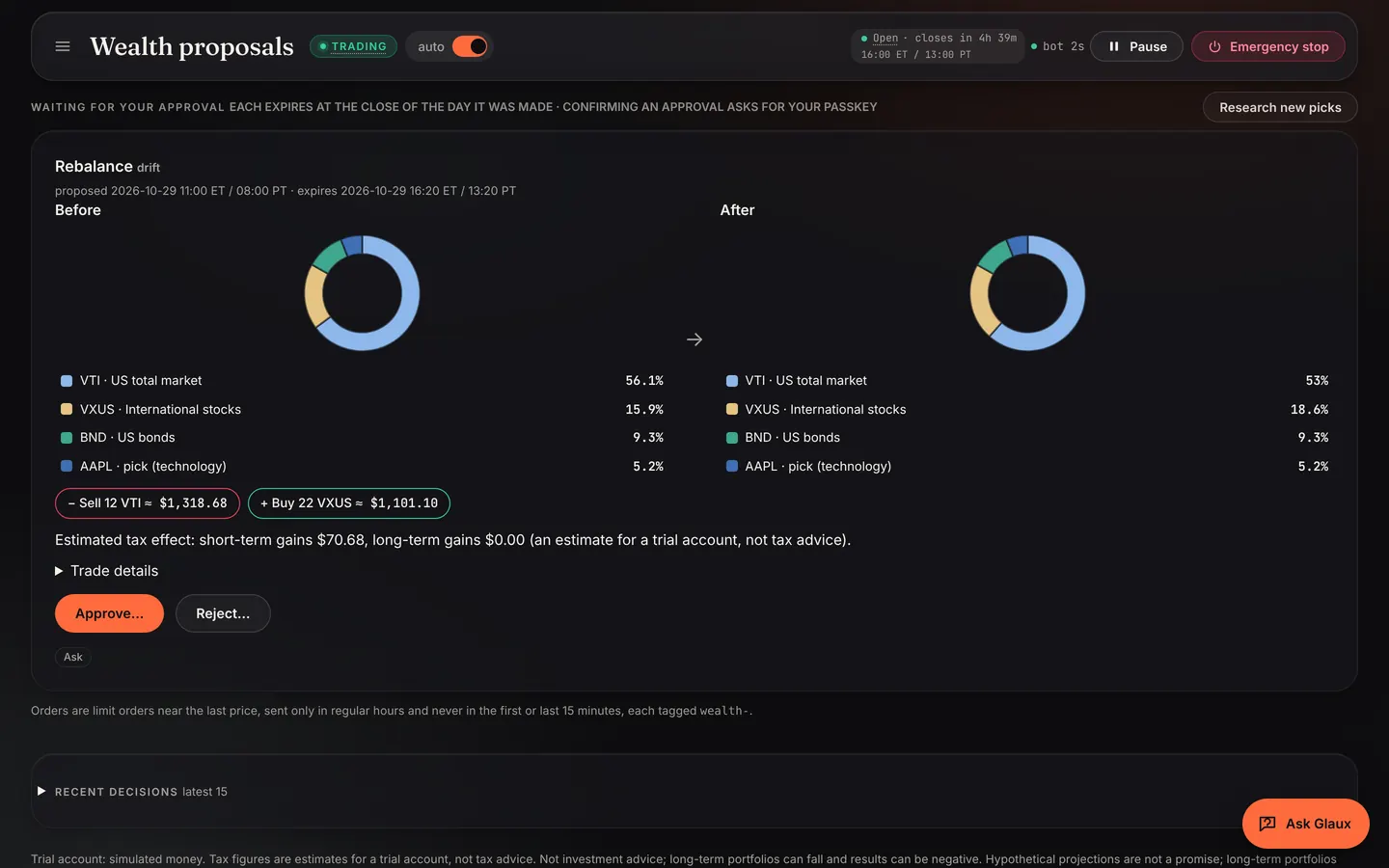
- A long-term portfolio of funds and researched stocks, rebalanced only with your approval.
- Income plans, dividends and tax-aware sales, all in pictures.
- Projections are hypothetical, shown as a range, with what they are based on.
Built like a quant desk
Five tests before a single trade.
Every strategy climbs the same ladder. Fail a rung and it stays in research.
- Same strategy, risk and execution code in backtest and live trading.
- Honest fills: a stop crossed by a gap fills at the open, with slippage, fees and borrow costs.
- Options math validated on 500 cases against a reference.
- Ready for ThetaData options history, Alpaca SIP data and a Schwab broker adapter.
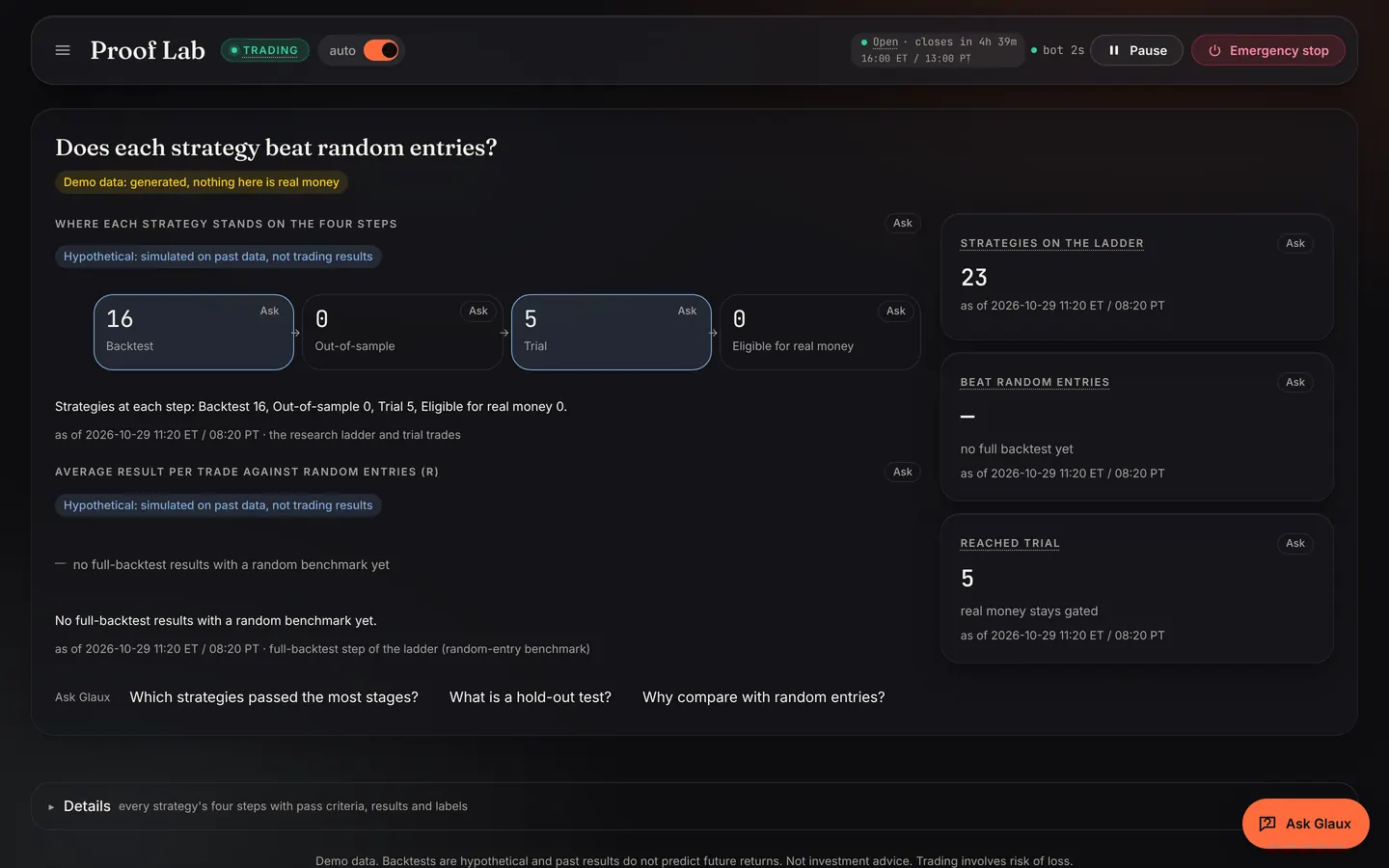
- 1Quick lookA few liquid names, every variant: at least half must show an edge.
- 2Full backtestAll history before the hold-out: at least 100 trades, positive after costs.
- 3Walk-forwardTune on 2 years, test the next 6 months, rolling: most test windows must stay positive.
- 4Hold-outThe latest 12 months, opened once.
- 5Stress5,000 bootstrapped years at double slippage set the risk per trade.
- ✓TradeOnly now does it trade.
Glaux shows its work
Every result, good or bad.
Every strategy climbs five stages of tests on data it has never seen, and the Proof Lab shows every result, including the strategies that fail.
- Even on a day it does not trade, the trading day check tells you exactly why: quiet by design, or what needs your attention.
- Every evening the evaluator grades every strategy and retires what stops working.


Risk first
Every trade has a way out before it has a way in.
The risk engine is plain code with the final veto: 27 rules, checked in order on every order. No agent can override it.
- A stop at the brokerEvery stock entry has a resting stop order from the moment it fills.
- Defined risk on optionsSpreads, butterflies and long straddles only, never naked short options: the most it can lose is known before it trades.
- Kill switchesNew entries stop at your daily loss limit, your weekly drawdown limit or a fall from the peak, each inside hard ceilings.
- Concentration limitsCaps on how much risk sits in one name and in one cluster of related names.
- Your approvalTelegram or the control center; a request you do not answer expires as a no.
- Your passkey on every controlFace ID or Touch ID unlocks approve, close and flatten.
Yours alone
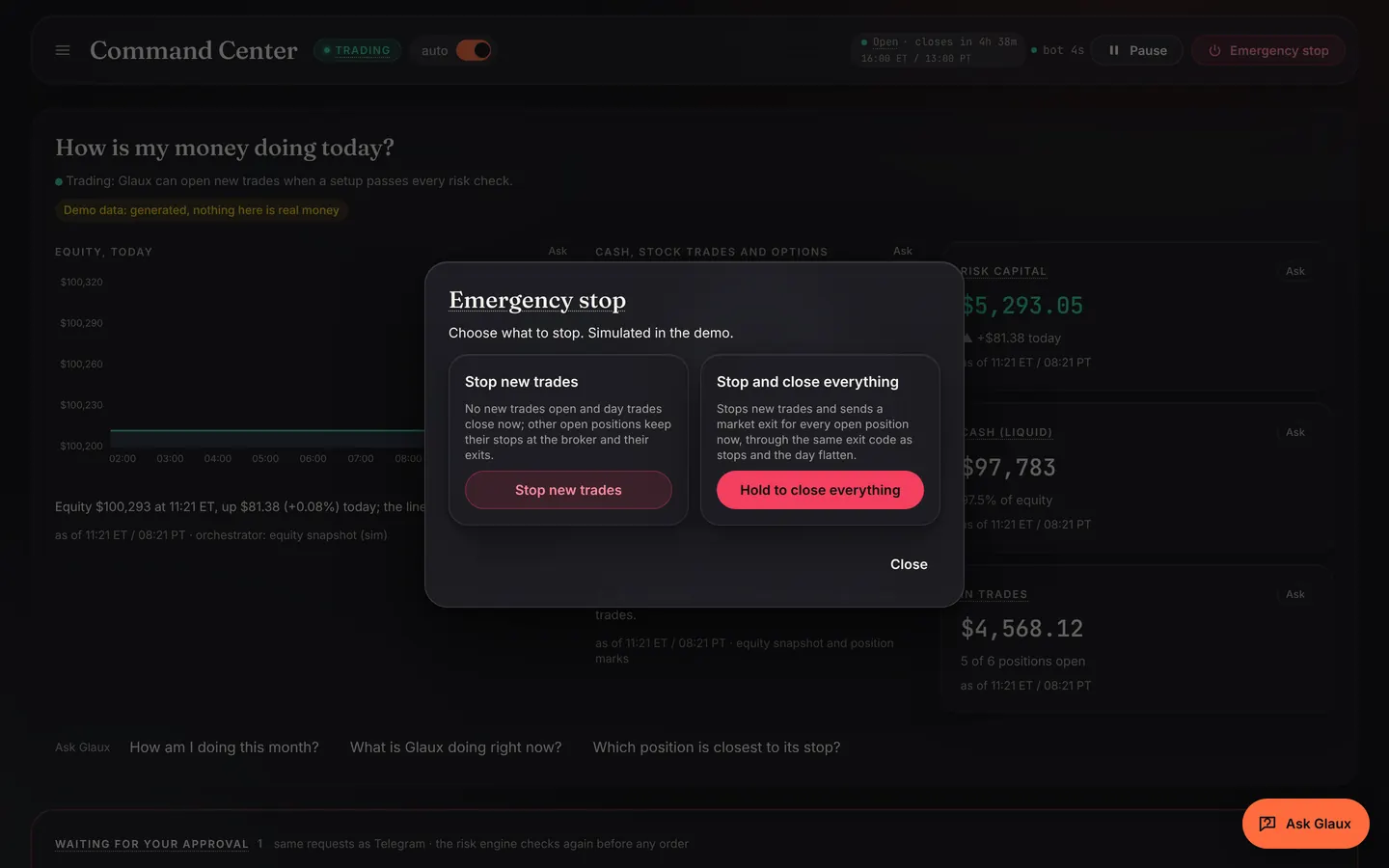
One tap stops new trades. Anywhere.
The Emergency stop halts new trades, or stops and closes everything. Passkeys guard every control, and your account is yours alone.
- On your desk and on your phone: the control center works the same on both.
- In Telegram: approvals and alerts where you already are.
- Inside the AI tools you already use, through the Glaux MCP connection, with keys you can revoke at any time.


Why “Glaux”
An owl on a silver coin.
Glaux (say “glowks”) is Athena's owl. Athens' silver tetradrachm, the most traded coin of the ancient world, carried it, and people simply called the coins “owls”. We tell the owl in words and borrow the symbols beside it.
- The owlAthena's owl on the coin people called “owls”: clear eyes in the dark.
- The crescent moonThe night watch: the desk keeps watch while you sleep.
- The olive branchPatient growth from trade, Athena's gift to Athens.
- The crossing xThe moment to act: in the name, a rising line crosses a falling one.
Historians still debate what the crescent on the coin meant. The reading above is ours, not settled history.
See it yourself
Watch it work. Then try it.
The whole desk in a few minutes: the agents, Autopilot, Ask Glaux, the tools, the proof and the safety. Every number in the film is generated demo data.
Watch the filmThe live demo is the real control center.
It runs on generated data that moves like a market day. No sign-up; every control is simulated, so press anything.
View demo
Questions
Questions, answered.
Which broker?
Alpaca, through its API, for stocks, ETFs and options. A Schwab adapter interface is built in for later.
Which markets?
US stocks and ETFs, and US equity options as defined-risk structures. Day trades use the opening-range breakout; swing trades last days. There is no scalping: AI is too slow for sub-minute trading, so Glaux does not try.
Can I try it?
Yes: the live demo is the real control center running on generated data. No account needed, and every control is simulated. A desk of your own starts with the waitlist.
When does Glaux launch?
Soon. Invitations go to the waitlist first, and full plans and prices go to the waitlist before the public launch.
What data does it use?
Market data from Alpaca (IEX by default, SIP when subscribed), SEC filings and 8-K items, news headlines, insider and congressional trade disclosures, and options chains. ThetaData options history plugs in when available.
Is this investment advice?
No. This page shows how a personal trading system works. It promises no results, and trading involves risk of loss.
Glaux is launching soon.
Join the waitlist to get in first, lock in founding-member pricing, and see pricing before anyone else.
- First in lineInvitations go to the waitlist first.
- Founding-member pricingA heavily discounted price, locked in for as long as you stay subscribed.
- Pricing firstFull plans and prices go to the waitlist before the public launch.
- Shape GlauxFounding members' feedback steers what gets built next.